September 2026 in TYPO3 Monthly summary
Releases 14.3.7 and 13.4.35, a high-severity advisory for v14, the start of CRA obligations, the camp season, the governance reform timetable – and one month until the end of support for v12. Status: 1 October 2026
In a nutshell
Security: On 8 September, releases 14.3.7 and 13.4.35, as well as ELTS versions for v10–v12, were published, addressing two security advisories. One of these – a high-severity vulnerability – affects v14 exclusively and allowed administrators without system administrator privileges to modify the configuration via the task scheduler.
Regulations: On 11 September, the obligation to report actively exploited vulnerabilities under the Cyber Resilience Act came into force. In Poland, the deadline for the registration of NIS2 entities is 3 October.
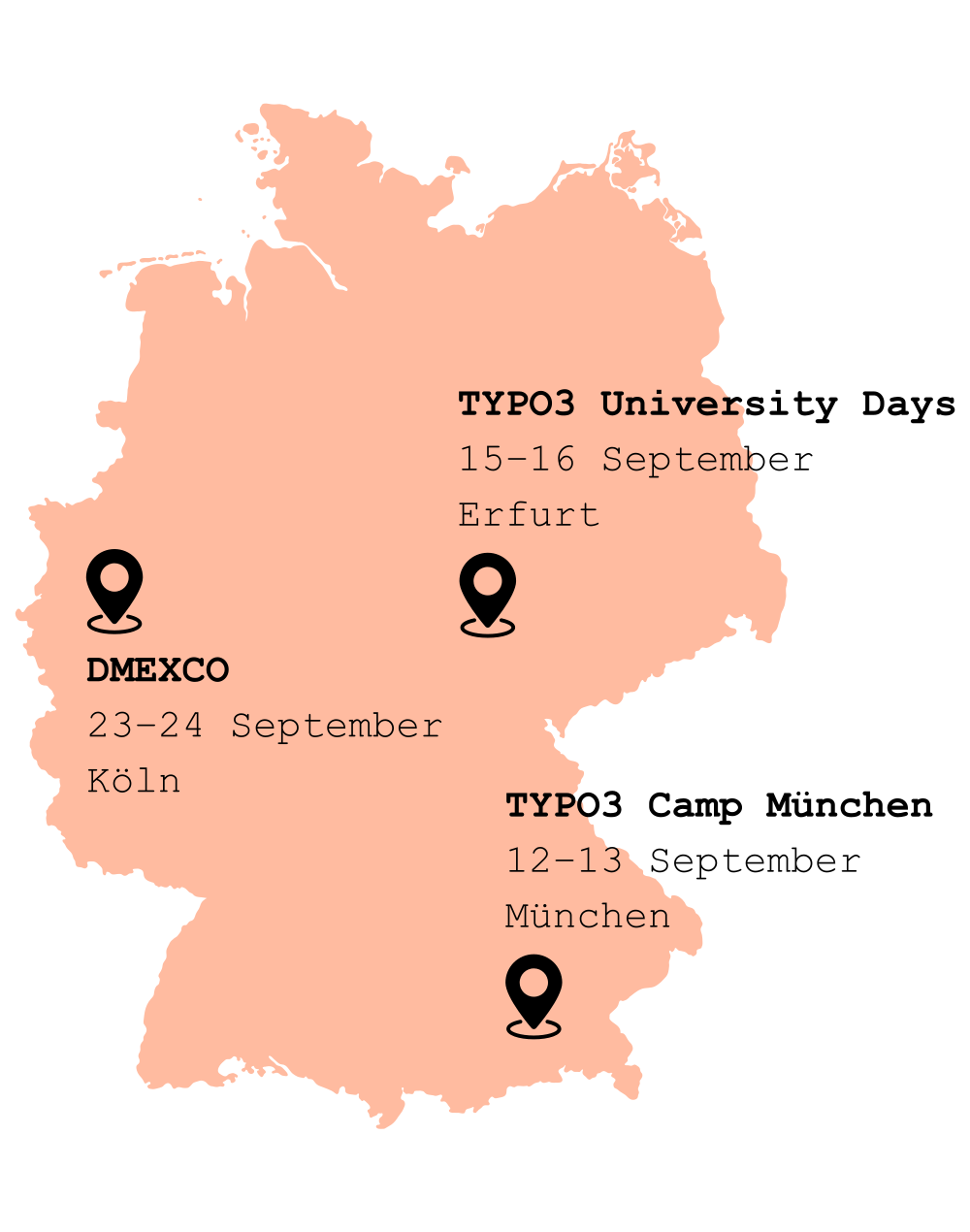
Events: Camp season: the nineteenth TYPO3 Camp München, University Days in Erfurt organised jointly by five universities for the first time, and DMEXCO in Cologne.
For Polish installations: There is one month left until the end of support for TYPO3 v12. If migration is not already underway, now is the last chance to decide.
Safety Two advisories, one of high priority
On 8 September, the TYPO3 Security Team released security updates 14.3.7 and 13.4.35, alongside ELTS versions 12.4.49, 11.5.54 and 10.4.60 for paid support of older branches. These patches address two vulnerabilities in the core:
 Disclosure of information by the localisation wizard, ALL LINES v10–v14
TYPO3-CORE-SA-2026-022 / CVE-2026-77132
Endpoints handling page translation in the backend did not correctly check page permissions, which allowed a logged-in user to access information about pages to which they did not have access rights.
 Lack of authorisation in low-level commands, HIGH – v14 ONLY (14.2.0–14.3.6)
TYPO3-CORE-SA-2026-023 / CVE-2026-85400
Backend administrators without system administrator privileges were able to use the task scheduler to execute commands to read, modify and display the system configuration.
The second vulnerability is noteworthy for two reasons. Firstly, it highlights the difference between the roles of an administrator and a system maintainer: in TYPO3, not every administrator should have access to the installation’s configuration, and this vulnerability failed to make that distinction. Secondly, this is the first serious vulnerability this year affecting only the new v14 branch – a reminder that the latest version does not mean there are no updates required.
No database changes are required following the installation of these releases, but it is recommended that you run the database analyser – optimisations have been introduced that are worth applying. Details of both advisories can be found at typo3.org/security; we provide a full overview of this year’s vulnerabilities in our guide.
The CRA in everyday life since 11 September
On 11 September 2026, the first binding provision of the EU Cyber Resilience Act came into force: the obligation for software manufacturers to report actively exploited vulnerabilities and serious incidents to ENISA and national authorities – with the first notification to be made within 24 hours. The regulation will come into full effect in December 2027, but some of the obligations are already in force.
For the TYPO3 ecosystem, this means that the preparations we have been writing about in recent months – the role of open-source software maintainer, the Association’s participation in the Eclipse Foundation working group, and the additional budget for compliance – have moved from the preparatory phase to the implementation phase. For agencies and extension developers selling TYPO3 software commercially, the reporting obligation is now their own responsibility.
For website owners, the direct impact is minimal for the time being – the CRA applies to developers, not users. The indirect impact, however, is clear: extension providers will have to patch vulnerabilities more quickly and communicate them more transparently, which will, over time, raise the security level of the entire ecosystem.
Camp season: Munich, Erfurt, DMEXCO
TYPO3 Camp Munich (12–13 September)
This camp marked its nineteenth edition. Over a hundred people gathered at a cultural centre near Munich for a barcamp-style event: the programme is put together on the spot, based on what participants want to hear and what others have to share. The topics covered a mix of AI, business and community. The event also featured a round-table discussion on how to develop TYPO3 camps as a format.
TYPO3 University Days (15–16 September, Erfurt)
The most interesting event from a Polish perspective. It was organised jointly for the first time by five universities in Thuringia, and the topics covered align almost perfectly with what we described in our article on Polish TYPO3 users: relaunches, multi-site installations, accessibility, governance, editorial workflows and long-term maintainability. German universities have their own regular forum for exchanging experiences – in Poland, where AGH, the University of Economics in Katowice and the universities in Szczecin use TYPO3, no such format currently exists. A certification exam was available on site.
DMEXCO (23–24 September, Cologne)
Europe’s largest digital marketing trade fair, where TYPO3 has been showcasing itself as an enterprise platform for years. Marketing decision-makers from the DACH region get to discover TYPO3 there alongside other commercial enterprise platforms.
Consultations closed, timetable finalised Governance
On 6 September, consultations concluded on the proposed Operating Principles for TYPO3 units – a document intended to define how the project will be organised from November onwards. In September, the Association’s Executive Board published two sets of minutes from its meetings – held on 2 and 16 September – which set out the timetable for the reform:
• end of October – an extraordinary online general meeting on amendments to the Articles of Association and the petition procedure,
• 4–5 November – launch day for the new units in Düsseldorf,
• 6 November – the new structure begins preliminary operations,
• 1 January 2027 – full budgetary implementation.
The minutes of 2 September also confirm the decision we reported on in our August summary: the establishment of the Public Sector Committee has been postponed until 2027. For the Polish public sector – the most important user of TYPO3 in the country – this means that, for the time being, its voice in the project is represented by agencies with practical experience of the sector, rather than by formal bodies.
It is worth keeping an eye on the October general meeting: this will be the first formal vote on the structure that will determine how TYPO3 is developed and funded in the coming years.
A Playbook for agencies and the silence surrounding TYPO3 Suite Ecosystem
On 29 September, an article was published on news.typo3.com ‘Building Business with TYPO3: A 90-Day Playbook for Agencies’ – a practical guide for agencies entering the ecosystem: how to build expertise, position their offering and secure their first clients within a quarter. Alongside the August guide on how clients should choose an agency, a series is being developed that provides clarity on the market from both perspectives.
What was missing in September, however, was the official announcement regarding the “TYPO3 Suite” that had been promised for that month. The July Dialogue Days promised that the concept and preliminary commercial structure would be ready for announcement in September – by the end of the month, no announcement had been made. It is possible that the matter has been put on hold pending the governance reform and will resurface after the launch of the new units in November. We note this without speculation: the Suite remains a concept; TYPO3 remains open source under the GPL licence.
October, with two fixed dates What lies ahead
• 3 October – the deadline for organisations to register in the S46 system (NIS2/KSC). Anyone who has not yet done so should still register.
• 13 October – planned maintenance releases 14.3.8 and 13.4.36.
• 15–17 October – TYPO3 Camp Berlin; 19–22 October – Community Sprint in Düsseldorf with certification exams; 20–21 October – Open Source CMS Conference in Utrecht.
• End of October – extraordinary general meeting of the TYPO3 Association online.
• 31 October – end of free security support for TYPO3 v12. One month to go.
• 4–5 November – launch day for the new TYPO3 units in Düsseldorf.
Two of these dates directly and irrevocably affect Polish installations: NIS2 and v12. The first is a legal obligation, the second a technical one. Both fall in the same month.
 Core update to 14.3.7 / 13.4.35
Update Core to 14.3.7 / 13.4.35. For v14 from 14.2.0 onwards – this is a high-priority update.
 Database analysis
After the update, run the database analyser – the releases include optimisations.
 Back-end permissions
Take a look at the permissions of backend administrators: should everyone have system administrator status? The vulnerability discovered in September related precisely to this distinction.
 Registration in the S46 system (NIS2/KSC)
Are you subject to NIS2? The registration deadline is 3 October. If this date has passed, register anyway and provide evidence of the reason.
 Migration?
Are you still on v12? There’s a month left. A decision must be made this week: a phased migration, ELTS as a stopgap, or a calculated risk.
 Reports
Do you develop or sell TYPO3 extensions? From 11 September, the CRA’s vulnerability reporting requirement also applies to you.
Frequently Asked Questions
For v14, versions 14.2.0 to 14.3.6 – yes, due to a high-severity advisory. For v13 and ELTS – moderate; the vulnerability in the localisation wizard requires the user to be logged in. In both cases, the update is quick and requires no changes to the database.
If you simply run it – not directly; the CRA covers software developers. If your organisation develops or sells TYPO3 extensions – the reporting obligation applies to you from 11 September.
The administrator has full access to the website’s content and configuration in the backend. A system maintainer is a role with additional permissions relating to installation tools and the configuration of the installation itself. Best practice: keep the number of system maintainers to a minimum, and not every administrator should be one.
The announcement due in September did not materialise. The matter remains open; it is likely to be revisited following the structural reform of the project in November. TYPO3 remains open source under the GPL licence.
About the author
Dr Blitz-Weblab is an agency specialising exclusively in TYPO3, with TYPO3 Silver Member status and an office in Kraków. For the past eight years, we have focused solely on this one system – working with clients in Poland and the DACH countries, ranging from public institutions and universities to foundations and manufacturing companies. We monitor every TYPO3 advisory and implement patches for our maintenance clients on the day of publication.
Are you on v12 and don’t have a plan yet? You’ve got one month left. Free pre-migration audit with a report within 48 hours: tel: 12 333 44 01. Email: [email protected].