August 2026 in TYPO3 Monthly summary
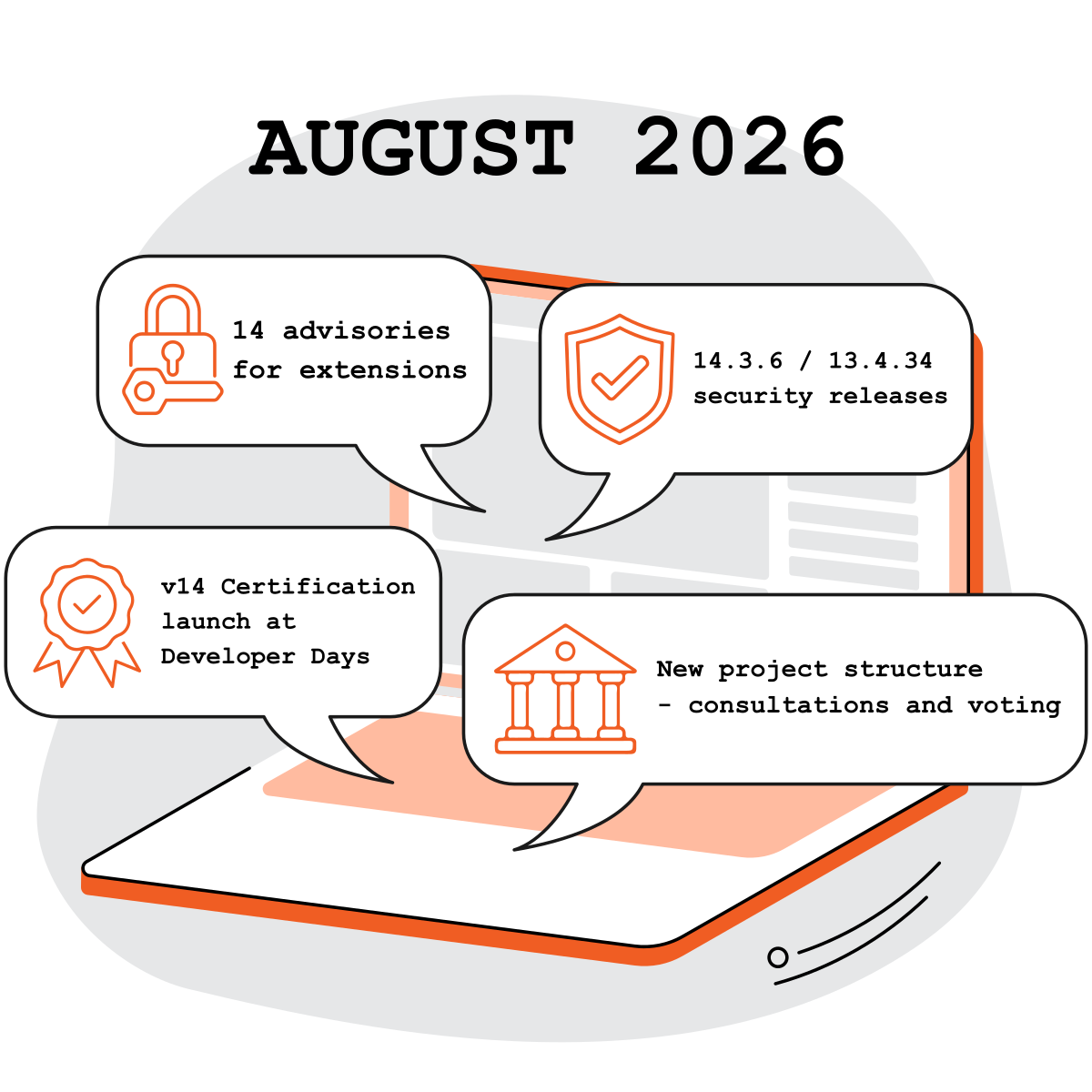
Fourteen advisories for extensions in a single day (including Powermail and Solr), security releases 14.3.6 and 13.4.34, the launch of v14 certification at Developer Days, the Visual Editor ready for production, and a month of decisions regarding the new project structure. Status: 23 September 2026
In a nutshell
Security: On 11 August, versions 14.3.6 and 13.4.34 were released, each containing a single fix in Core. On 25 August, the Security Team published fourteen advisories for extensions in a single day – including Powermail, femanager, Apache Solr, Mask and event handling extensions.
Developer Days: TYPO3 v14 certification exams made their debut in Karlsruhe on 6–8 August. A public draft of the new project structure was also published there.
Governance: The operating principles for TYPO3 units were put out for consultation, independent mediation regarding the Code of Conduct was initiated, and six budget proposals were put to a vote by members.
For Polish installations: Powermail is used on almost every Polish TYPO3 site. If you haven’t updated your extensions since 25 August, this is essential reading.
August in the TYPO3 ecosystem was a month of contrasts. On the one hand, it was a month of organisational activity: consultations on new project operating rules, budget votes and board minutes. On the other hand, it was one of the most intense months of the year in terms of security, with a wave of security advisories affecting the most popular extensions in the ecosystem. We’ve compiled the most important events from a practical perspective for those maintaining TYPO3 websites in Poland.
Fourteen security advisories for extensions in a single day Safety
On 11 August, TYPO3 security releases 14.3.6 and 13.4.34 were published – for both branches simultaneously. These were accompanied by the only core security advisory this month:

 Backend and Install Tool – bypassing access control
TYPO3-CORE-SA-2026-021 Broken Access Control
vulnerability in the administration panel and installation tool. For the severity rating and further details, please refer to the official advisory at typo3.org/security. Fixed in 14.3.6 and 13.4.34; if you are running either of these versions, you should prioritise updating to these releases.
However, the real highlight of the month was 25 August. On that day, the TYPO3 Security Team published fourteen coordinated advisories for third-party extensions (the TYPO3-EXT-SA-2026-014 to -027 series). This is the second such wave this year – following the one in May for extensions and the one in June for the Core – and, in some respects, the most significant, as it affects extensions present in the vast majority of installations:
✗ Powermail – the most popular form extension in the ecosystem, present on almost every Polish TYPO3 website that has a contact form
✗ femanager – front-end user management, registration and login
✗ Apache Solr for TYPO3 – a full-text search engine used on large portals and university websites
✗ Mask – a tool for building custom content elements, often forming the foundation of an entire template
✗ Events 2 and Event Management and Registration – event management and participant registration
✗ and further extensions from the same series
Powermail is particularly important for Polish installations. The contact form is where a website collects personal data – and a vulnerability in the extension that handles forms is a potential route to that data. For organisations subject to the GDPR and NIS2, updating Powermail after 25 August is not a matter of choice, but a documented obligation. It is also worth remembering that data from forms can be further protected by encrypting it in the database – so that even in the event of an incident, it remains unreadable.
This wave confirms the conclusion we have been repeating since the start of the year: across the ecosystem, the vast majority of vulnerabilities affect extensions, not the core. The Security Team itself encourages you, following a month like this, to go through the list of installed extensions in composer.json and check each one for its maintenance status in the TYPO3 Extension Repository. An extension that is no longer being developed will not receive a patch – and this is a real risk, regardless of the core version. We provide a full overview of this year’s vulnerabilities in our guide to TYPO3 security vulnerabilities.
Launch of v14 certification Developer Days
The TYPO3 Developer Days 2026 took place in Karlsruhe on 6–8 August under the slogan ‘Next Gen TYPO3’ – the most important developer event of the year. The most significant development for the market was the launch of the TYPO3 v14 certification exams: from now on, developers, integrators, consultants and editors can demonstrate their expertise in the latest version of the system. The exams are now also available at upcoming events – in Munich and Erfurt in September, and in Berlin and Düsseldorf in October.
For clients selecting an agency, the team’s certifications are one of the few objective indicators of quality; for agencies, they are a factor in establishing credibility in tenders. It is worth noting that v14 certification covers changes that have a real impact on day-to-day work: less emphasis on TypoScript, and more on Fluid and modern configuration mechanisms.
During Developer Days, a public draft of the proposed new project structure – announced in July at Dialogue Days – was also published. This brings us to the second topic of the month.


The month in which the decision on the project’s structure was taken Governance
August was a month of organisational work – and it’s worth keeping an eye on this, as decisions regarding the structure of the TYPO3 Association will shape how the project is developed and funded in the coming years. Key developments:
• On 6 August, the proposed Operating Principles for TYPO3 Units, together with the concept for the Units Collaboration Panel, were put out for consultation – with a deadline for comments of 6 September. This is at the heart of the reform: the division of the project into units with their own responsibilities and budgets.
• From 1 September, an independent, external point of contact for reporting incidents relating to the Code of Conduct has been operational – alongside the existing Ombudsperson Committee. This was preceded by a webinar on 26 August explaining how mediation will work in practice.
• On 5 August, six budget proposals from the third round were put to a vote by members – four from the community and two from the teams.
• The board minutes from 6 and 19 August cover, amongst other things, the conflict of interest policy, a proposal to establish an Enterprise Committee, and early preparations for the Cyber Resilience Act.
What does this mean for an observer from Poland? In early September, the board postponed until 2027 the establishment of the Public Sector Committee – a body that was intended to gather the views of public institutions and translate them into recommendations for the roadmap. The reason is understandable: the board is focusing on structural reform. But this means that the public sector – TYPO3’s most important user base in Poland – must, for the time being, rely on agencies that understand its specific needs from practical experience, rather than on the project’s formal structures.
The reform timetable is already known: an extraordinary online general meeting at the end of October, the launch of the units on 4–5 November in Düsseldorf, the new structure will begin operating on a provisional basis from 6 November, and full budgetary implementation will take effect from 1 January 2027. However, the official announcement regarding the ‘TYPO3 Suite’, which was due in September, has still not been made – the matter remains open.
Visual Editor ready for production, Content Blocks in v14, GEO guide Ecosystem
Three announcements from August have a direct impact on the day-to-day work of editors and integrators.
✓ The Visual Editor has been declared production-ready following a project funded by the community budget. Work has focused on accessibility, reliability and multilingual editing processes. The path to integration into the core remains open – this is currently the most promising direction for editors who wish to edit content directly in the page preview.
✓ The Content Blocks graphical interface now works on v13 and v14 from a single codebase, according to the Content Types team’s quarterly report. The JSON schema has seen further improvements. Content Blocks is a forward-looking way of defining custom content elements – it’s worth considering for new v14 implementations.
✓ A practical guide to GEO (Generative Engine Optimisation) for TYPO3 has been published: how to split content into fragments, use structured data and configure multilingual support so that content has a chance of being cited in AI-generated responses. Written for content creators, not just developers – and consistent with what we described in relation to the new ‘Agentic Browsing’ category in PageSpeed Insights.

Among the opinion pieces, it is worth noting the comments by the Vice-President of the TYPO3 Association on digital sovereignty – the argument that the changes taking place in the European public sector represent an opportunity for the project, rather than a threat – as well as a report from the North American Summit focusing on the difference between built-in features and the proliferation of plugins: multilingualism, workflows and permissions as part of the core, rather than an add-on. An official guide to selecting a TYPO3 agency has also been published – a resource well worth sharing with clients during the contractor selection process.
The community in figures
August core contribution report: 80 contributors (up from 61 in July), 44 patch authors, 148 reviews – including 4 new features, 62 bug fixes and 78 maintenance tasks – as well as 13 people improving the documentation. The number of words translated on Crowdin has reached a record high: over 300,000, compared with just over 6,000 the previous month. This surge is most likely the result of a large-scale, coordinated translation effort – good news for Backend users in languages other than English and German.
What lies ahead? September and October
• 11–13 September – TYPO3 Camp Munich.
• 15–16 September – University Days in Erfurt (a meeting between the academic sector and agencies, with on-site certification exams).
• 23–24 September – DMEXCO in Cologne.
• 3 October – the deadline for entities to register in the S46 system, following the amendment to the KSC Act (NIS2), is approaching. There are ten days left.
• 15–17 October – TYPO3 Camp Berlin.
• 19–22 October – event in Düsseldorf featuring certification exams.
• End of October – extraordinary general meeting of the TYPO3 Association online regarding amendments to the articles of association.
• 31 October – end of security support for TYPO3 v12. Five weeks to go.
• 4–5 November – launch day for the new TYPO3 units in Düsseldorf.
• 9–10 November – fourth quarterly board meeting.

Administrator’s checklist for after August
 Update Core to 14.3.6 / 13.4.34
These are security releases, not maintenance releases.
 Check the extension versions
Check the versions of Powermail, femanager, Solr, Mask and the event extensions against the advisories dated 25 August. Start with Powermail.
 Browse the full list of extensions
Go through the full list of extensions in composer.json and check the maintenance status of each one in the TYPO3 Extension Repository. Abandoned extensions pose a risk regardless of the core version.
 Are you on v12? There are five weeks left.
If the migration is not currently underway, it’s time to decide: a phased migration or ELTS as a stopgap.
 Are you subject to NIS2?
The registration deadline is 3 October. Document the August updates as part of your vulnerability management process.
Frequently Asked Questions
Check the version of the extension against the advisory dated 25 August at typo3.org/security. If it is older than the patched version, update it immediately. Powermail handles personal data, so this is a high-priority update. Regardless of this, consider encrypting the tickets stored in the database.
It certifies proficiency in the current version – for developers, integrators, consultants and editors. For clients, it serves as an objective indicator when selecting an agency; for agencies, it is a selling point in tenders. Exams are available at upcoming TYPO3 events across Europe.
The TYPO3 Security Team coordinates releases – it collects reports, verifies them, waits for patches from extension authors, and publishes a series of updates all at once once the fixes are ready. Co-ordinated release is standard practice in secure projects: it minimises the time between a vulnerability being disclosed and a patch becoming available.
Indirectly – yes. The new structure is intended to give project units their own responsibilities and budget, which should speed up development and decision-making. For the Polish public sector, it is worth noting that the establishment of a dedicated committee has been postponed until 2027 – for the time being, the sector’s voice is represented by agencies familiar with its specific characteristics.
How can we help?
The August wave of advisories is precisely the scenario for which maintenance contracts exist: patches deployed on the day of publication, a review of extensions following each series of advisories, and documentation for the NIS2 audit – without the customer having to keep track of the release calendar. We also assist with migrations from v12 during the final window before the end of support, and with encrypting data from Powermail forms.
Telephone: 12 333 44 01. Email: [email protected].